
Compare YouTube Ads vs Search Ads and you’ll notice the difference isn’t always in numbers — it’s in conversations. A few months ago, a client said something that really stayed with me: “I’m getting leads… but none of them feel right.” He wasn’t frustrated, just exhausted. He had been running Google search ads for months. Leads were coming in regularly, and everything looked fine in reports. But when his sales team followed up, the calls felt flat. People were mostly browsing, asking for prices, or looking for free advice. Very few were actually ready to move forward.
When he asked me if he should stop Google Ads and try something else, I didn’t tell him to stop. I told him to add YouTube ads. We didn’t create anything fancy — just simple videos explaining what his service does and who it’s really for. Over the next few months, something changed. The leads coming from YouTube already understood his work. They asked smarter questions. They felt more aligned. Without forcing it, the budget slowly shifted because the quality spoke for itself. After spending 12 years doing this at Kapture Digital, I’ve seen this pattern more times than I can count. So the real comparison between YouTube Ads vs Search Ads isn’t about which platform is better — it’s about which one brings leads that actually feel right.
Table of Contents
ToggleUnderstanding the Real Difference Between YouTube Ads and Search Ads
Search ads are those text advertisements you see at the top of Google when you search for something. They say “Sponsored” in tiny letters, but otherwise they look pretty similar to regular search results. Someone types “best pizza delivery Chicago,” your ad shows up, they click it, boom—they’re on your website or calling your restaurant. Simple.
YouTube ads are video commercials that play before, during, or after YouTube videos. Sometimes they’re those little banner ads on the side too. You’ve got options like the skippable ads where people can hit “Skip Ad” after 5 seconds, non-skippable ads they have to watch completely, and bumper ads that are super short (6 seconds).
The fundamental difference? Search ads target what people are actively looking for right now. YouTube ads target who people are and what they’re interested in, then interrupt them with something relevant.
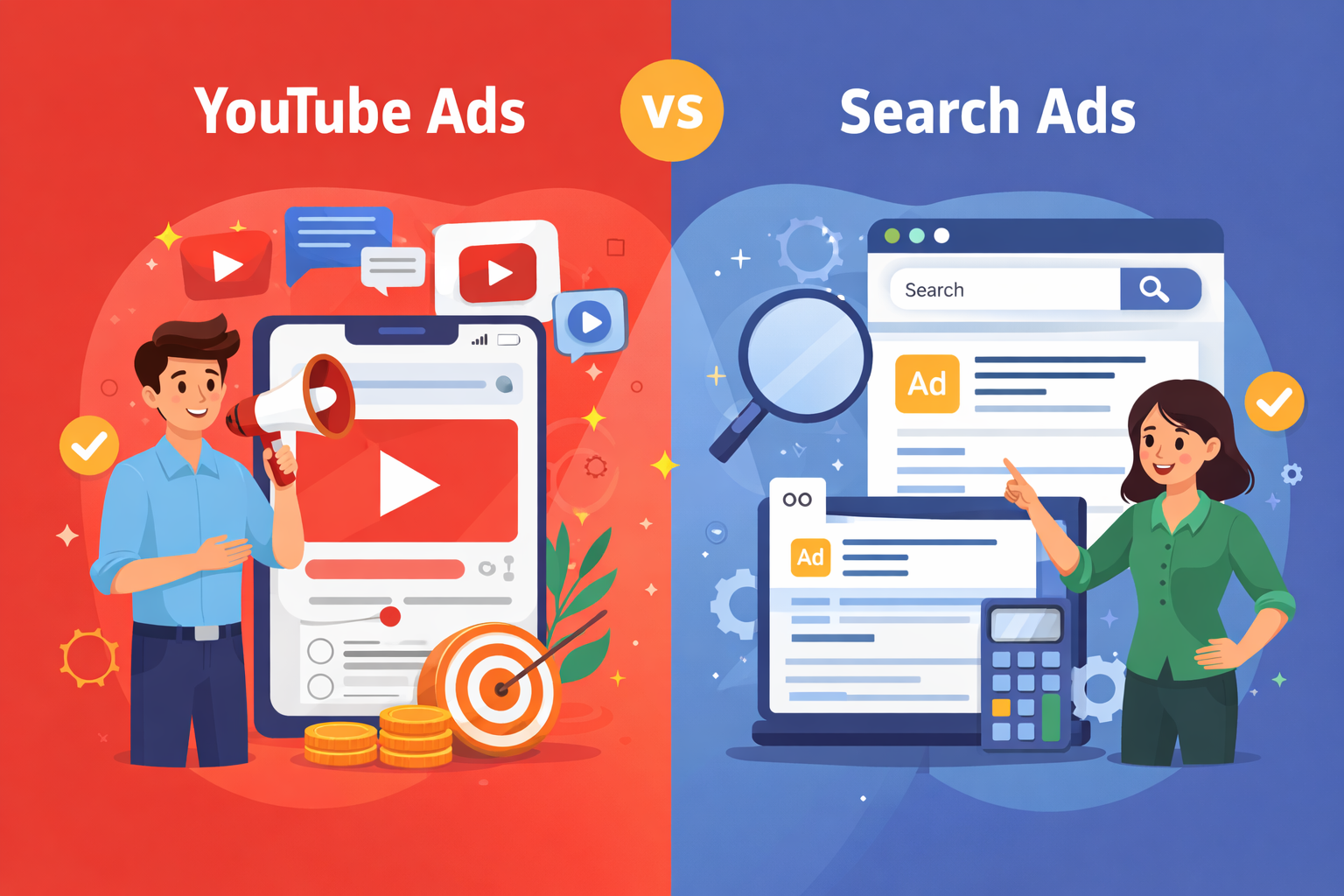
When you compare YouTube ads vs search ads from a targeting perspective, it’s like comparing a fishing rod to a net. Search ads are the fishing rod—you’re targeting specific keywords, specific intent, specific moments. YouTube ads are the net—you’re casting wider based on demographics, interests, and behaviors.
Let me give you a real example from Kapture Digital. We worked with a guy selling specialized running shoes. With search ads, we targeted keywords like “best trail running shoes” and “running shoes for flat feet.” We knew exactly what people wanted. With YouTube ads, we targeted people who watched running channels, fitness content, and marathon training videos. Different approach, different mindset.
Here’s the thing about where people are in their buying journey. Search ads are amazing for bottom-of-funnel stuff. That’s marketing speak for “people who are ready to buy right now.” They’ve done their research, they know what they want, they’re comparing final options. YouTube ads work better for top-of-funnel (people just becoming aware of a problem) and middle-of-funnel (people researching solutions but not ready to buy yet).
The creative side is totally different too. Creating a search ad takes maybe 30 minutes. You write some headlines, descriptions, throw in your keywords, done. Creating a YouTube ad? You need a camera, lighting, a script, someone comfortable on camera, editing software, music… it’s a whole production. Not impossible, but definitely more work.
At Kapture Digital, we’ve seen businesses fail at YouTube not because the platform doesn’t work, but because they tried to do it cheap. They filmed themselves on a phone with bad lighting, rambled for 90 seconds, and wondered why nobody watched. Meanwhile, their competitor invested $2,000 in a professional video that was tight, engaging, and compelling—and crushed it.
Search ads are also more straightforward to track. Someone clicks your ad, lands on your site, fills out a form, done. You know exactly which keyword drove that conversion. YouTube is messier. Someone might see your ad today, think “interesting,” then Google your company three days later and buy. The YouTube ad deserves credit for that sale, but tracking it is complicated.
Search ads are intent-driven.
They respond to existing demand. When someone types a search query, they already want something — a service, a solution, or a product. Your search ad appears at the exact moment that intent is expressed.
YouTube ads are intent-shaping.
They reach people earlier in the journey. The user may not be actively searching yet. They’re watching videos, learning, or scrolling. Video advertising allows you to explain your offer, show how it works, and build trust before the user ever clicks.
This difference has a direct impact on lead quality.
Search ads reach people who are already in decision mode.
YouTube ads reach people before the decision is fully formed.
Neither approach is wrong. They simply play different roles in the lead generation funnel — one captures intent, the other creates it.
What “High Quality Leads” Actually Means
When businesses compare YouTube Ads vs Search Ads, the mistake is treating all leads as equal. A lead is not just a form fill or a missed call—it’s a person at a specific stage of decision-making. Search Ads usually attract people who are actively looking for a solution right now. Their intent is clear, but their understanding is often shallow. Many are still exploring options, comparing prices, or testing the market. This is why search leads come faster, but not always better.
YouTube Ads, on the other hand, work differently. Video advertising allows you to explain your service, set expectations, and filter out the wrong audience before they ever click. By the time a YouTube lead reaches out, they already know who you are, what you offer, and roughly what to expect in terms of pricing or process. This early education plays a big role in lead quality and improves the chances of meaningful sales conversations.
Another overlooked factor in lead generation quality is sales effort. Search leads often require more follow-ups, more explanation, and more convincing. Your sales team spends time answering basic questions instead of closing deals. With YouTube Ads, fewer leads may come in, but they tend to be more aligned. These prospects ask smarter questions, move faster through the funnel, and convert with less resistance. Over time, this reduces sales fatigue and improves overall conversion rates.
This is why comparing cost per lead alone creates the wrong conclusions. A lower cost doesn’t help if the leads don’t convert. When you look at YouTube Ads vs Search Ads through the lens of cost per customer, sales efficiency, and conversion quality, the picture becomes much clearer. One channel captures demand; the other builds it. The right strategy isn’t choosing one over the other—it’s understanding which type of intent your business needs at this stage of growth.
Why Search Ads Feel Powerful (But Often Disappoint)
Search ads feel safe. There’s comfort in the simplicity of them. Someone searches, clicks your ad, fills a form, and you expect a conversion. That clean flow is why many businesses start their digital marketing service journey with search ads. And to be fair, they do work well in the right situations—especially for emergency services, strong local intent, simple offers, and problems that need an immediate solution.
The issue starts when search ads become the only channel. As competition grows and keywords get broader, the quality of conversations begins to drop. Many people clicking your ads are still researching, comparing prices, or just trying to understand the market. Some are quietly looking for free advice, even when the keyword seems commercial. On paper, lead numbers look great, but behind the scenes, sales teams struggle to move those leads forward.
What search ads can’t do is filter mindset. They capture urgency and curiosity, but not readiness. Someone may want information right now, but that doesn’t mean they’re ready to commit or pay. This is why lead quality from search ads can feel inconsistent over time. Without another layer in your digital marketing service that educates and prepares the audience, businesses often end up spending more energy qualifying leads than closing them
Why YouTube Ads Often Bring Better Conversations
When businesses compare YouTube Ads vs Search Ads, the answer is rarely about choosing one platform over the other. It’s about understanding how people decide. Search ads meet people in moments of urgency. YouTube ads meet them earlier, when they’re still forming opinions and expectations. Both play an important role in a modern digital marketing service, but they solve different problems.
If your business needs fast visibility and immediate demand capture, search ads can deliver. If your business needs better conversations, warmer prospects, and leads that understand your value before speaking to sales, YouTube ads often do the heavy lifting. The mistake isn’t using search ads. The mistake is expecting them to filter intent on their own.
Real lead quality isn’t measured inside dashboards. It shows up in follow-up replies, smoother sales calls, fewer objections, and conversions that don’t feel forced. Over time, the businesses that win aren’t the ones chasing cheaper leads—they’re the ones building better understanding before the click.
So instead of asking which platform is better, ask a more useful question: Do you want faster leads, or better-prepared ones?
The right mix of YouTube Ads and Search Ads gives you both—and that balance is where sustainable growth actually happens.

Cost Per Lead vs Cost Per Customer (Big Difference)
Cost Per Lead vs Cost Per Customer (Big Difference) is one of the most misunderstood concepts in digital marketing, and this confusion quietly drains ad budgets. Many businesses judge digital marketing performance only by cost per lead, assuming cheaper leads mean better results. On the surface, search ads often look more affordable because they generate faster inquiries at a lower cost per form submission. YouTube ads, in comparison, can seem expensive initially. But when you step back and evaluate the full digital marketing funnel, the reality changes. Leads generated through YouTube digital marketing campaigns tend to close at higher rates, require fewer follow-up calls, stay longer as paying customers, and perceive greater value in the service. This happens because video-based digital marketing builds trust, clarity, and expectation before the first sales conversation begins. Prospects already understand the offer, credibility, and positioning by the time they reach out. So while search ads often win on speed, YouTube ads consistently win on efficiency and customer quality over time. At Kapture Digital, we measure success using one metric that actually reflects business growth—cost per real customer, not cost per lead. And when digital marketing performance is evaluated this way, YouTube Ads regularly deliver stronger long-term returns than most businesses expect.
YouTube Ad Formats That Actually Work for Leads
YouTube Ads perform best for lead generation when they are planned as part of a structured digital marketing journey. Each ad format plays a specific role in moving prospects closer to a decision. Video Action Campaigns are effective because they focus on driving actions like form fills or calls, making them ideal for mid- to bottom-funnel intent. YouTube Discovery Ads work well earlier in the funnel, where users are still exploring solutions and willingly choose to engage with your content. This choice-driven interaction often results in stronger lead quality because the interest is genuine, not forced.
Retargeting YouTube Ads add another layer of efficiency to lead-focused campaigns. When you show follow-up videos to people who have already watched part of your content or visited your website, the conversation feels familiar rather than intrusive. These warm audiences usually convert faster, ask fewer basic questions, and show higher trust during sales conversations. This is where YouTube Ads outperform many other digital marketing channels in terms of conversion efficiency.
What limits YouTube Ads for lead generation is not the platform—it’s the approach. Running a single video with no sequencing, no retargeting, and no intent-building rarely delivers consistent results. YouTube is not designed for instant decisions; it’s designed for influence. When treated as a one-time ad placement, results feel weak. When treated as a journey that educates, reassures, and reinforces value, YouTube becomes a powerful driver of high-quality leads.
This is why businesses that succeed with YouTube Ads for digital marketing don’t chase viral videos or quick wins. They focus on clarity, consistency, and intent progression—guiding prospects step by step until reaching out feels like the natural next move.
B2B vs Service Businesses: Platform Choice Matters
When businesses choose between YouTube Ads and Search Ads, the smartest decisions come from understanding how buyers think—not from following trends. In B2B and high-ticket services, the buying journey is rarely instant. Multiple stakeholders are involved, risks feel higher, and decisions take weeks or even months. This is where YouTube Ads add real value. Video allows brands to educate, explain complex offerings, and build familiarity over time. Clients working with ASDM often notice that YouTube-generated leads arrive more prepared, ask deeper questions, and require less basic explanation during sales calls.
For local services and quick solutions, the psychology is different. The buyer already knows what they need and wants it solved now. Search Ads work well here because they capture urgency at the exact moment of intent. Someone looking for an immediate service isn’t comparing long-term value—they’re looking for availability, location, and speed. In these cases, YouTube Ads may support awareness, but search advertising usually drives faster conversions.
The key insight is that lead quality improves when the ad format matches the buyer’s mindset. Using YouTube Ads for education-heavy decisions and Search Ads for urgency-driven needs creates balance across the funnel. Businesses that partner with ASDM and apply this approach don’t chase volume—they design campaigns around intent, timing, and trust. That’s what turns advertising into predictable growth instead of inconsistent results.

Conclusion
The debate between YouTube ads vs search ads doesn’t have a universal winner because different businesses have different objectives, audiences, and resources. What we’ve explored throughout this comprehensive analysis is that both platforms offer distinct advantages that make them valuable tools in your digital marketing arsenal.
Search ads excel at capturing explicit intent, delivering immediate results, and converting bottom-of-funnel prospects who are ready to make a decision. They’re measurable, relatively straightforward to implement, and provide quick feedback on what’s working. For businesses that need leads today and operate in spaces where search intent is clear, they remain an absolutely essential marketing channel.
YouTube ads excel at building brand awareness, telling compelling stories, demonstrating products visually, and nurturing prospects through longer consideration cycles. They allow for creative expression that text ads simply cannot achieve, and they can reach people who don’t yet know they need what you offer. For businesses selling complex solutions or building brand recognition, they represent an opportunity to connect with audiences in more meaningful and memorable ways.
At Kapture Digital, our recommendation for most businesses is to view this not as an either-or decision but as a strategic allocation question. Start by understanding where your prospects are in their buyer journey. Identify whether your primary challenge is awareness, consideration, or conversion. Assess your creative capabilities and budget realistically. Then allocate your resources across both platforms in a way that addresses your specific weaknesses and leverages your specific strengths.
If you’re just beginning your digital advertising journey and need to choose one platform to start with, let your business model guide you. If people actively search for what you sell and you have a clear value proposition that can be communicated in text, start with search ads and expand to YouTube once you’ve proven your conversion funnel works. If your product or service requires education or demonstration, or if you’re trying to create a new category where search volume doesn’t yet exist, YouTube ads might be your better starting point despite the higher creative barriers.
Remember that the difference between YouTube ads and search ads extends beyond just the format and placement. It’s about different stages of awareness, different psychological states when ads are encountered, and different paths to conversion. The most sophisticated marketers don’t ask which platform is better—they ask how each platform fits into a comprehensive strategy that guides prospects from first awareness all the way through to conversion and beyond.
The landscape will continue to evolve. AI will get better at optimizing campaigns automatically. New ad formats will emerge. Privacy regulations will continue to shape what’s possible. But the fundamental difference between intent-based search advertising and interruption-based video advertising will remain, and understanding that difference will continue to be the foundation of smart advertising strategy.
Frequently Asked Question
Yes, YouTube ads can generate high-quality leads, especially for businesses that need to educate their audience before selling. People who watch your video understand your offer, pricing, and value better before filling out a form. This often results in fewer but more serious leads who are easier to convert, compared to people clicking search ads without fully understanding the service.
Search ads usually attract higher immediate intent because users are actively searching for a solution. However, high intent does not always mean high quality. Some searchers are only comparing prices or looking for free information. Search ads work best for quick decisions and urgent needs, but lead quality depends heavily on keyword selection, landing page clarity, and proper filtering.
Neither platform is automatically better. YouTube ads often drive higher quality leads for complex, high-ticket, or trust-based services because they educate users first. Search ads usually deliver faster leads and higher volume. Businesses that measure quality based on conversions, customer value, and sales conversations often find YouTube leads more qualified, while search leads arrive faster but require more filtering.
YouTube ads may look more expensive when you compare cost per lead, but they are often cheaper when you compare cost per actual customer. Search ads usually have lower cost per lead but lower conversion rates. YouTube leads often convert better because viewers are pre-educated through video. The real comparison should be cost per customer, not just cost per lead.
A business should use YouTube ads when the product or service needs explanation, trust-building, or education. This is common for B2B services, premium offerings, coaching, real estate, and high-value products. YouTube ads are also effective when customers are not actively searching yet, but fit a clear audience profile that can be targeted through video.
Search ads work better when customers have an urgent or immediate need, such as local services, repairs, or simple purchases. They are ideal when people already know what they want and are searching with strong intent. Search ads are also effective for businesses that need quick lead volume and have a short sales cycle with minimal education required.
Businesses should measure lead quality beyond form submissions. Key indicators include response rate, sales-qualified leads, conversion rate, deal size, and customer lifetime value. Feedback from sales teams is also important. In 2026, quality leads are those that understand the offer, match the target customer profile, and convert with less resistance—not just leads that are cheap or high in number.
There is no single best platform for all businesses. Google Ads are best for immediate leads and service-based businesses, while Meta Ads are ideal for branding and audience engagement. In 2026, Ahmedabad businesses achieve the best results by aligning ad platforms with business goals, target audience behavior, and budget—often using both platforms strategically.